
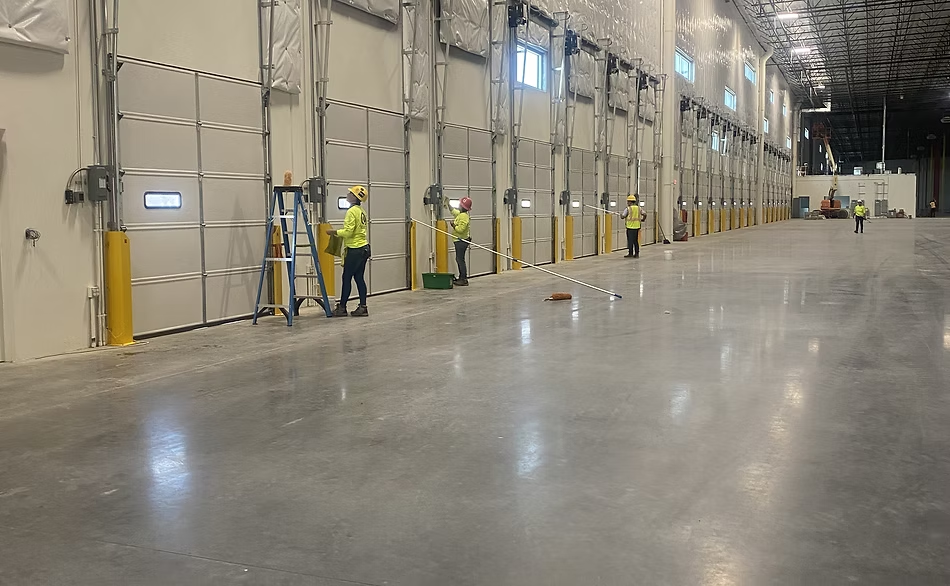
Manufacturing & Distribution
Industrial, warehouse and distribution cleaning
Large-footprint cleaning with the right equipment: ride-on scrubbers, high-bay dusting and crews trained to work safely around active operations.
- Ride-on scrubbers
- High-bay capable
- OSHA-trained crews
Request a free quote
Tell us about your facility. We respond the same business day.
- OSHA-Trained Crews
- Bonded & Insured
- BBB Accredited
- Green Cleaning Certified
- 100% Satisfaction Guarantee
- Self-Performing W-2 Crews
Facilities We Serve
Industrial Facilities we clean
Manufacturing Plants
Production floors, tool rooms and staging areas.
Warehouses & DCs
Racking aisles, dock doors and staging lanes.
Cold Storage & Food
Sanitation-sensitive environments with strict protocols.
Fleet & Maintenance
Shops, apparatus bays and equipment yards.
How We Operate
What this sector actually requires
Cleaning a facility in this category carries obligations a generic janitorial scope doesn't cover. These are the ones we build into the program.
Equipment scaled to the footprint
Ride-on and walk-behind scrubbers, sweepers and lifts sized so a large floor plate is cleaned within your available window.
Working around operations
Crews are briefed on traffic patterns, forklift routes and restricted zones, and work to your lockout and PPE requirements.
High-bay and overhead
Lift-assisted dusting of racking, structure, ductwork and light fixtures on a scheduled cycle.
Dock and yard control
Dock levellers, seals and approaches cleaned to reduce debris tracking into the facility.
Our Method
How we clean industrial facilities
At industrial scale the constraint is almost never willingness, it is equipment and access. A 200,000 square foot floor plate cannot be cleaned with walk-behind machines inside a single shift, and no amount of extra labor fixes that. So the method starts from machine selection and the window operations can actually give us, then works backwards to the schedule.
Size the machine to the plate and the window
Ride-on scrubbers, industrial sweepers and walk-behind units are selected against square footage and available hours. Published rates put a warehouse at roughly 6,000 to 8,000 square feet per hour with ride-on equipment and about half that walk-behind, which is the calculation that decides whether your floor finishes in one shift.
Zone around live operations
Crews are briefed on forklift routes, traffic patterns, restricted zones and your lockout and PPE requirements before the first shift, then work zone by zone so production is never waiting on cleaning. Aisles are released back to operations promptly rather than held for convenience.
High bay on a scheduled cycle, not on complaint
Racking, structural steel, ductwork, sprinkler lines and light fixtures are dusted from scissor and boom lifts on a planned cycle. Overhead dust is a housekeeping issue until it becomes a fire-inspection or product-contamination issue, so it is scheduled rather than reactive.
Docks controlled because they feed the whole building
Dock doors, levellers, seals, staging lanes and approaches are cleaned deliberately, since debris tracked from the dock is the source of most of the soil load inside the facility. Cleaning the plate without controlling the dock means cleaning the same soil repeatedly.
Degrease and reseal on wear, not on calendar
Soil load, not the month, sets the degreasing frequency, and sealed concrete is resealed when wear shows rather than on a fixed rotation. We inspect the surface and tell you when it is due, which is usually cheaper than either extreme.
Staff the shift pattern that exists
Programs commonly run second or third shift, between shifts, or continuously where the facility operates around the clock. We staff to the pattern rather than asking a 24-hour operation to create a shutdown window it does not have.
Built to published industry standards
Labor is workloaded on ISSA production rates, the quality system follows the CIMS management framework, green practice follows Green Seal GS-42, and chemical handling follows OSHA Hazard Communication with EPA-registered products held to label contact time.
- ISSA
- Green Seal
- OSHA
- EPA
Scope of Work
What a standard program includes
Every scope is written per facility after a walkthrough. This is the baseline we start from for industrial facilities, then adjust to your square footage, frequency and hours.
- Ride-on scrubbing of production and warehouse floors
- High-bay racking and structural dusting
- Dock door, leveller and staging area cleaning
- Restroom, locker and break room sanitation
- Office and administrative janitorial
- Periodic degreasing and floor sealing
Questions
Industrial Facilities cleaning: common questions
Other Sectors
We also clean
Get a quote for your facility
Send us your square footage and service needs. We'll walk the building, put a written scope in front of you, and hold the price.
Free quotes · Same business-day response · No obligation